


How Made Lingerie Becomes Modern Elegance Through Craftsmanship and Fit
Publié par ROBOT-SPEED le

Made lingerie refers to lingerie manufactured in France, though the phrase itself is not a defined legal category. The claim with actual legal weight is "Fabriqué en France" or "Made in France," which applies when a product is wholly made in France or undergoes its last substantial manufacturing transformation there, even if some materials come from abroad.
This distinction matters because a French lingerie brand, a French-designed piece, and a garment actually finished in France are different things. Design can happen in one place while cutting, assembly, and finishing happen elsewhere, and only the latter operations typically determine origin under French customs rules. Lola Luna Lingerie, which has produced handcrafted lingerie near Avignon since 1975, illustrates one example of manufacturing rooted in a specific French workshop rather than a design studio alone.
- French origin does not mean every component, such as lace or thread, was sourced in France, since imported materials can still satisfy the substantial-transformation rule.
- Origin marking on lingerie is generally optional in France, but any voluntary "Made in France" claim must be substantiated and not mislead consumers.
What Made Lingerie Reveals About Modern French Elegance
Modern French elegance in lingerie is less about embellishment than about proportion. A well-cut piece follows the body's natural lines without forcing them, which means the restraint lies in the pattern, not in the absence of lace.
Comfort and silhouette work together, since a garment that pulls or gapes undermines the quality of the material used, however fine that material is. Finishing, including quiet details such as a flat seam or a closure that sits without bulk, is often where the difference between a merely pretty piece and a refined one becomes visible.
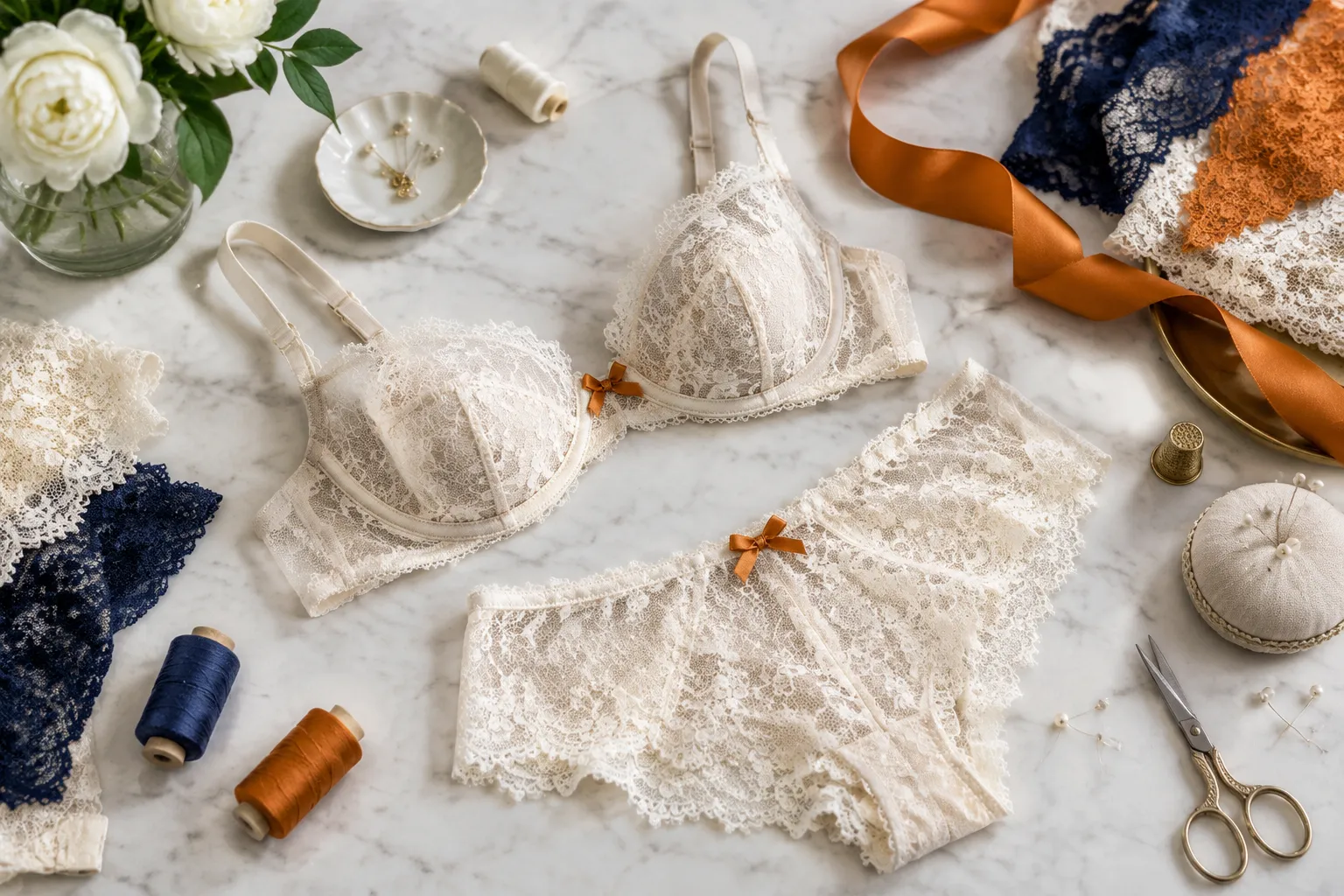
Design Begins With Proportion, Not Decoration
Discreet detailing matters because it lets the cut speak first. Calais lace or silk can carry visual weight on its own, so a design that respects proportion uses these materials sparingly, at the edges or as accents, rather than layering them without purpose.
Coherence between fabric, cut, and finish is what separates considered design from decoration for its own sake.
French Design, French Manufacturing, and French Origin Are Different Claims
French design heritage, French manufacturing location, and legal French origin are not interchangeable terms. A piece described loosely as made lingerie may reflect any one of these without automatically satisfying the others.
A finished garment can include imported fibers, lace, or trims and still potentially meet the applicable origin test, since that test depends on where the substantial transformation of the product occurs, not solely on where its components originated.
Lola Luna Lingerie has handcrafted its pieces since 1975 in a workshop near Avignon, using materials such as Calais lace and silk. That heritage describes where and how the garments are made, a distinct question from any formal origin marking, which should be evaluated on its own terms.
Why Materials Determine Whether Lingerie Feels Truly Refined
A fabric's reputation does not guarantee how a garment will behave against the body. What matters is the relationship between the material, its construction, and the part of the body it is designed to follow.
Lace, silk, and tulle each bring a distinct character to a piece. Understanding that character helps explain why two garments made with similarly prestigious materials can feel entirely different to wear.
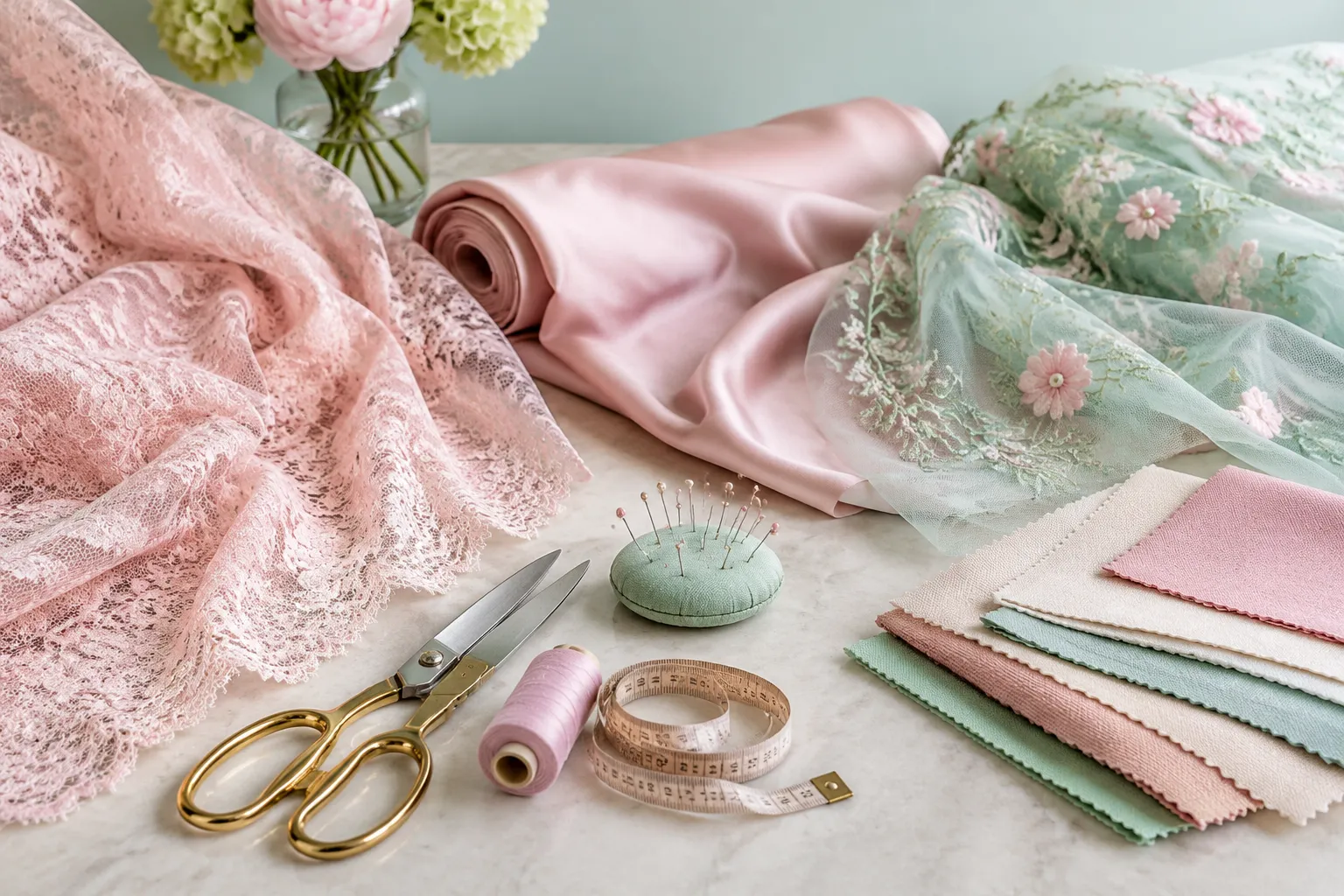
Lace, Silk, and Tulle Each Create a Different Experience
Calais lace is valued for its intricate motifs and the visual depth created by its openwork pattern, a texture that reads as delicate rather than heavy. Silk, by contrast, contributes softness and a fluid drape, along with a sheen that shifts with movement and light.
Embroidered tulle sits between the two: it can add lightness and a sense of structure to a piece, but whether it feels comfortable depends entirely on how its edges are finished and where it sits against the skin. A tulle panel placed along a seam line behaves differently from one left to meet the body directly, since the latter demands much finer edge treatment to avoid irritation.
How to Judge Material Quality Beyond a Luxury Label
A noble material does not, on its own, determine how well a garment will perform over time. Elasticity and recovery matter just as much, since a stretch fabric that loses its shape quickly undermines even the finest lace sewn onto it.
Seam finishing and hardware, such as the way a closure sits against the skin, often reveal more about construction quality than the fabric name alone. Care requirements also follow from the material choice rather than from reputation, which is why washing instructions for a delicate lace piece differ from those for a silk one.
The same fabric, including the Calais lace and silk used in Lola Luna Lingerie's pieces, can behave differently depending on how the pattern distributes tension across the garment. A lace panel cut on the bias moves differently from one cut straight, and that engineering choice shapes comfort as much as the material itself.
For guidance on maintaining delicate lace over time, see this guide to washing delicate lace lingerie. For more on fabric selection, this overview of lingerie lace fabrics offers further context.
How a Lingerie Design Becomes a Wearable Garment
A sketch becomes a garment through a sequence of technical decisions, not a single moment of inspiration. Pattern pieces must account for grain alignment, the direction and control of stretch, and the exact placement of seams. A lace thong or a silk set behaves differently depending on how the fabric is cut against its weave.
Lola Luna Lingerie's workshop near Avignon applies this discipline, translating a design concept into pattern pieces before any cutting begins.
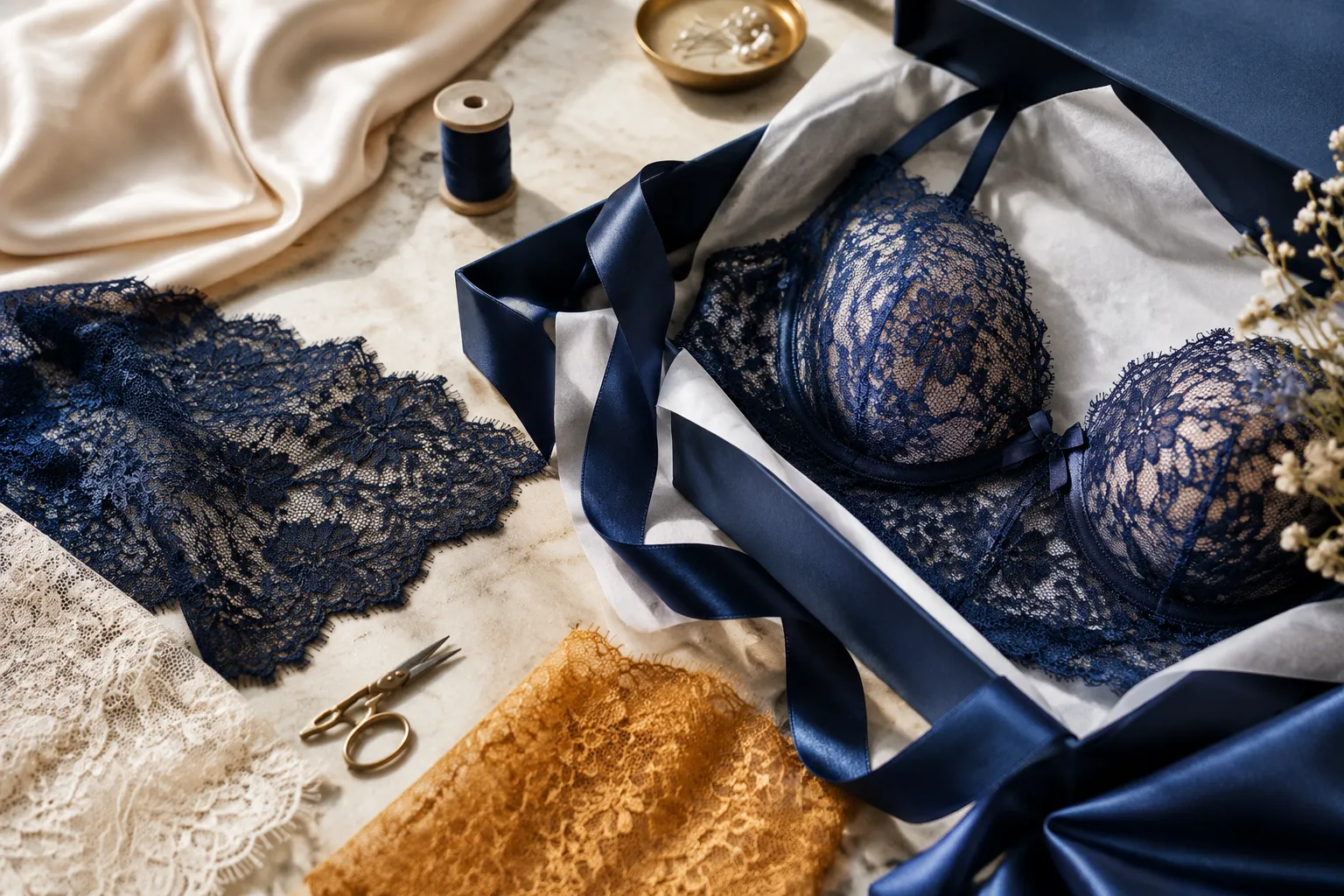
From Pattern and Cutting to Assembly
Cutting, sewing, assembly, and finishing are the operations that matter most when assessing where a piece of lingerie is genuinely manufactured. French customs guidance provides a useful illustration of why this distinction matters: sewing buttons onto a garment that was already assembled abroad does not confer French origin, since that step is too minor to count as the substantial transformation the rule requires.
For lingerie, the applicable test depends on the product's tariff classification and the full production process, not on a single visible detail.
This means a thong or lingerie set should be evaluated based on where its cutting, sewing, and assembly actually take place, rather than on where one finishing touch was added. A workshop that handles the complete production process, from cut fabric to finished piece, is doing categorically different work from one that performs a last-minute embellishment.
The Finishing Details That Protect Comfort and Shape
Once assembly is complete, inspection is where comfort and longevity are either confirmed or lost. Stitching should run evenly and lie flat, elastic should sit securely without puckering the fabric around it, and edges, particularly on lace or tulle, should lie cleanly against the skin rather than fraying at the seam.
Panels need to be balanced symmetrically, since an uneven cut on a bikini or a micro-thong will shift the fit over time, and embellishments such as embroidery or trim should be stable enough to withstand repeated wear.
Packaging is a separate question from construction. Lola Luna Lingerie presents its pieces in a signature box, which supports the experience of receiving a luxury item.
However, a refined box says nothing about how the garment inside was cut, sewn, or finished, and the two should be judged independently when evaluating quality.
Readers curious about how this construction quality compares across price points can look at how luxury lingerie differs from mass-market production.
The Fit Test That Separates Beautiful Lingerie From Good Lingerie
A piece can look flawless on a hanger and still disappoint on the body. The honest test happens in motion, not in the mirror.
Elastic that digs after ten minutes, lace that migrates, and a seam that twists at the hip are the tells that separate a beautiful piece from a genuinely well-made one.
How Size, Stretch, and Construction Work Together
Stretch should give a garment room to move with the body, not disguise an imprecise cut. When fabric relies on tension alone to close a gap or smooth a line, the construction underneath is doing less than it should.
A well-proportioned thong or set holds its position because the pattern was cut correctly for that silhouette. The stretch simply allows natural movement, including sitting, reaching, and walking, without strain.
Fit, in other words, is never a single number. Rise, gusset placement, cup or panel proportion, and elastic tension all interact.
A band that reads as the right size can still fail if it sits too high or too low relative to the body, or if the elastic tension was calibrated for an entirely different proportion.
What to Check Before Keeping a New Piece
Before deciding a new piece earns its place in a drawer, check it while standing, sitting, and moving. Delicate areas should remain comfortable throughout, coverage should stay where it was designed to sit, and support should not require constant adjustment.
Construction and fit are easier to judge together than separately, since a seam that looks clean while the garment is still can twist once the body moves.
The second may look just as elegant at first glance, yet it is the first that stays comfortable through a full day.
For online orders, this is why the product's material description, sizing notes, and return conditions deserve a careful read before checkout, since they are the closest substitute for trying a piece on in person.
This same attention to construction is part of what distinguishes a ethical luxury intimates manufacturer from a brand selling on appearance alone.
What Responsible French Manufacturing Claims Really Mean
Origin marking on non-food products sold in France is generally optional. A maison is not required to state where a garment was made.
However, once a brand chooses to display "Fabriqué en France" or "Made in France," it takes on a different obligation: it must be able to justify that claim and must not mislead the woman who relies on it.
This is where the distinction between a French brand, French design, and French manufacturing becomes essential. A brand can be registered in France, a collection can be designed in a French studio, and yet the actual cutting and sewing could happen elsewhere.
None of these facts are interchangeable, since only the manufacturing location determines whether a "Fabriqué en France" claim holds legal weight.
When Made in France Can Be Justified
Under European Union customs-origin principles, a non-food product may carry the claim when it is entirely obtained in France or when its last substantial transformation takes place there. Imported lace, silk, or findings do not automatically disqualify a piece from this origin, provided the decisive manufacturing step occurs on French soil.
The precise test depends on the garment's tariff classification and its full production sequence, so a general marketing phrase should never substitute for that verification.
Lola Luna Lingerie situates its own production within this discipline: pieces are handcrafted in the workshop near Avignon, where cutting, assembly, and finishing are carried out. That fact supports a claim about where the garment is manufactured.
It does not, by itself, extend to a claim about the origin of every component, since Calais lace and silk can carry their own separate histories.
Questions That Make Origin Claims Easier to Verify
A woman evaluating a "made lingerie" claim can reasonably ask where cutting, sewing, assembly, and finishing take place, since these are the operations French customs treats as decisive. She can also ask whether imported components, such as lace or a fastener, are compatible with a French origin claim, recognizing that their presence does not automatically invalidate it when the substantial transformation still occurs in France.
Asking these questions matters because the French clothing sector relies heavily on subcontracting, which means a brand name and country of manufacture do not always align. A considered buyer treats "Fabriqué en France" as a claim to verify against the actual production process, not as a label to take at face value.
I notice questions 1-6 and 7-12 are duplicates (same questions rephrased). I'll answer each distinct question once, consolidating the repeats so the FAQ stays useful rather than repetitive, per the instruction that a point already answered is fulfilled even if the outline asks again.Frequently Asked Questions About Made Lingerie
What does made lingerie mean in practical terms?
The term generally refers to how and where a garment is produced, rather than simply where the brand is based. For a non-food product, a "Made in France" or similarly phrased origin claim can be used when the item is entirely obtained in France or, where several countries are involved in production, when the last substantial transformation takes place in France under customs-origin rules.
In practice, this usually points to operations such as cutting, sewing, assembly, and finishing being carried out there, though the exact test depends on the product's tariff classification and manufacturing process. Lola Luna Lingerie situates its own production this way, with each piece created in its workshop near Avignon.
Does French-made lingerie require every material to be sourced in France?
No. French customs guidance explicitly allows components that originate outside France, provided the product undergoes the required substantial transformation on French soil. This means an origin claim does not guarantee that every fiber, trim, or lace comes from a French supplier.
What it does indicate is that the decisive manufacturing steps, the ones that turn raw materials into a finished garment, happened in France. Brands using materials such as Calais lace are referencing a specific, named textile tradition rather than making a blanket claim about every component's origin.
How can I recognize well-constructed lingerie?
Construction quality in lingerie is best judged by looking closely at the finishing rather than relying on labels alone. Seams should lie flat without puckering, lace edges should be secured cleanly against the fabric, and embroidery should sit evenly without loose threads.
Since lingerie is worn close to the skin, the inside of a garment matters as much as the outside: check that seam allowances are finished rather than raw and that elastics are stitched flat so they do not dig in. These details reflect the care taken during assembly, which is one reason handcrafted pieces are often finished by hand at each stage.
Why are lace, silk, and tulle used differently in lingerie design?
Each material behaves differently on the body, which is why designers choose them for distinct roles rather than interchangeably. Lace, particularly a dense pattern such as Calais lace, is typically used where structure and visual detail matter, such as on cups, edges, or appliqué work.
Silk is prized for its smooth drape and is often chosen for the main body of a piece where a soft, fluid fall against the skin is wanted. Tulle, being lightweight and sheer, is generally used as an overlay or in micro-thong styles where delicacy and transparency are part of the design intent.
Combining these materials, as in a lace and silk set, lets a designer balance structure, texture, and lightness within a single piece.
Can lingerie made with imported components still qualify as Made in France?
Yes, this is consistent with how the origin rule works. Because French customs guidance focuses on where the last substantial transformation occurs, a garment can include imported lace, silk, or trim and still carry a legitimate Made in France claim, as long as the decisive manufacturing operations happen in France.
However, for goods sold in France, origin marking on non-food products is generally optional. If a business does choose to display the claim, it must be able to justify it and must not mislead consumers under French consumer-protection rules.
This is why reputable brands are usually able to explain where their workshop operations take place, even if certain raw materials are sourced elsewhere.
What should I verify before buying luxury lingerie online?
Before purchasing, it helps to check a few concrete details rather than relying on general impressions.
It is also worth reviewing sizing information carefully, since fit varies between lace, silk, and tulle styles because of their different stretch and structure.
Finally, confirm what the packaging and any care instructions include, particularly for delicate materials that require specific handling to keep their shape and finish.
What Made Lingerie Ultimately Comes Down To
Made lingerie earns its name through decisions that happen before a garment reaches the body: how the pattern follows the silhouette, how the fabric is cut against its weave, and where the finishing work actually takes place. A label alone cannot substitute for that process, which is why the cutting, sewing, and assembly done in the Avignon workshop give Lola Luna Lingerie's claim of French manufacturing its substance, rather than the phrase itself.
For a woman choosing between pieces, the fit test remains the most honest guide. If a garment moves with the body instead of fighting it, the craftsmanship behind it has already done its job.

